
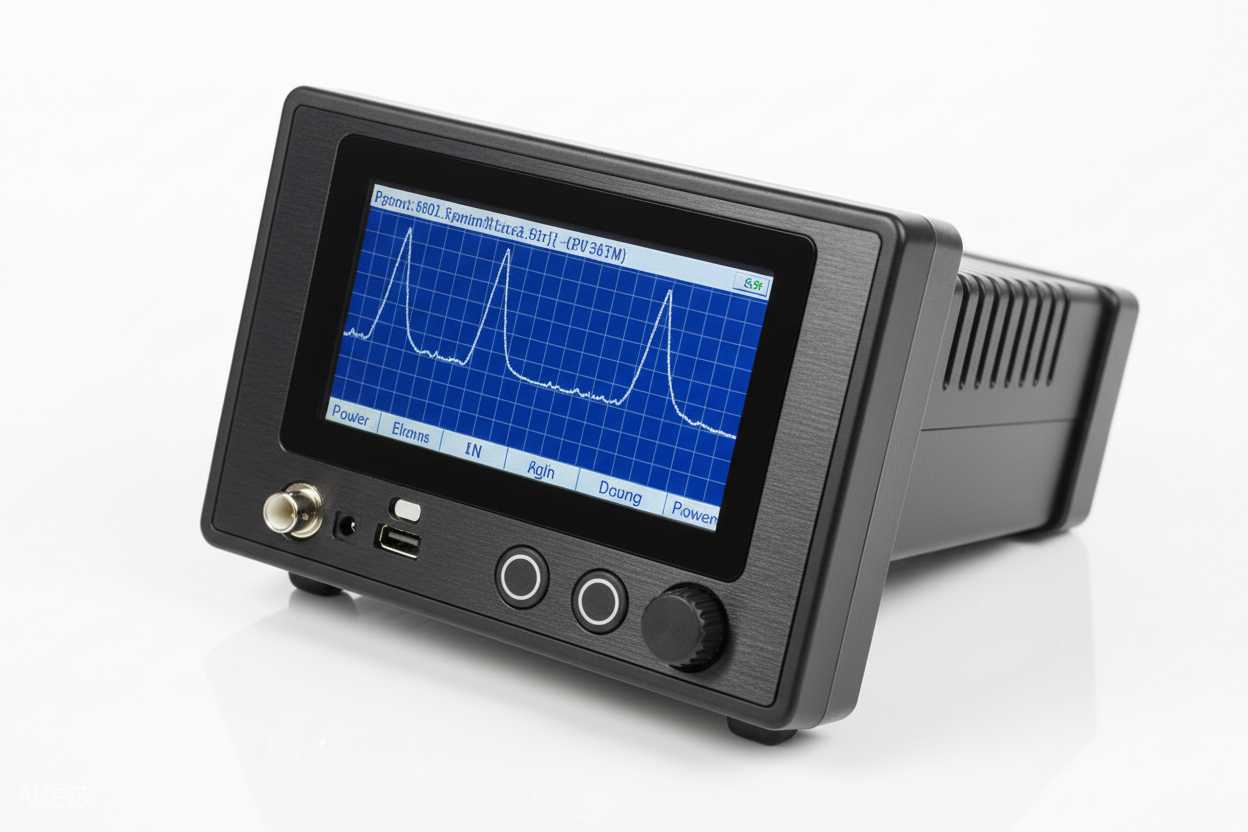
For decades, γ spectrometer systems have commonly relied on analog pulse processing chains: preamplifiers, shaping amplifiers, and then input to multichannel analyzers via analog-to-digital converters. This architecture is feasible but has a fundamental limitation—once the hardware is built, the signal processing logic is fixed. Enhancing energy resolution, adjusting shaping time constants, or increasing pile-up event suppression often means redesigning the circuit board.
FPGA-based digital MCAs have changed this situation. The original detector signal is digitized immediately after being amplified, and all subsequent processing—trapezoidal shaping, baseline restoration, pile-up event detection—is performed in programmable logic. This is not a minor implementation detail but fundamentally alters the capability boundaries of the spectrometer instrument and changes how manufacturers and system integrators iterate instrument designs.
Core Technical Advantages: Programmable Signal Processing
The decisive feature of FPGA-based pulse processing is that the signal chain is software-defined rather than hardware-fixed. This leads to several direct conclusions:
Pile-up event suppression has shifted from a hardware constraint to a solvable problem. At high count rates, pulses generated by continuous radiation interactions may overlap, distorting the measured energy spectrum. Analog systems typically handle this issue by simply discarding ambiguous pulses with dead-time circuits—a crude solution that wastes counting rate capability. Digital systems can detect pile-up characteristics directly from the waveform and apply correction algorithms, preserving more effective counting rates even at higher dose rates.
Trapezoidal shaping replaces fixed RC shaping networks. Classic analog shaping amplifiers use fixed time constants, forcing the system to trade off between energy resolution (favoring longer shaping times) and counting rate capability (favoring shorter shaping times). Digital trapezoidal filters implemented in FPGA logic can adjust shaping parameters without any hardware changes; in more advanced implementations, they can even dynamically adjust shaping times based on measured counting rates.
The system becomes field-reconfigurable. Since the signal processing logic resides in firmware, digital MCAs can be updated with improved algorithms after deployment. The instrument's nuclide identification library, energy calibration routines, and pulse shape discrimination logic can all be optimized through firmware upgrades rather than hardware revisions—this is a substantial advantage for instruments that need to be deployed in the field for years.
Why the Differences Are More Pronounced in High Count Rate Scenarios
The performance gap between analog and digital pulse processing is most pronounced under high radiation field conditions—precisely the scenarios where reliable measurements are most needed in the nuclear industry, homeland security, and emergency response applications. Published FPGA γ spectrometer studies indicate that systems can maintain stable operation at counting rates exceeding 400,000 pulses per second, whereas analog systems experience significant resolution degradation due to pulse pile-up in this range.
This is also where the parallel processing architecture of FPGA holds an advantage over other digital solutions. Pile-up suppression algorithms need to complete multiple concurrent operations within a single clock cycle—detecting pulse beginnings, tracking baselines, integrating charge, and simultaneously marking overlapping events. General-purpose microcontrollers or even dedicated DSP chips struggle to maintain this processing capability at high count rates because their architectures are designed for sequential processing. In contrast, FPGAs can implement these operations as parallel hardware logic modules, maintaining full throughput capability even in count rate ranges where sequential processors fall behind.
Trade-offs: Why Not Everyone Uses FPGA
If this analysis only showcases the advantages of FPGA digital MCAs without acknowledging their costs, it would be incomplete. FPGA-based systems require firmware development using hardware description languages (VHDL or Verilog), which presents a much higher engineering barrier than writing software for microcontrollers. Development cycles are longer, and debugging parallel-running digital logic is fundamentally different from debugging sequentially executed code.
This is why simplified MCA versions based on microcontrollers (like ARM Cortex-M or similar embedded processors) still hold a place in the market. For applications with lower count rate requirements, low-cost embedded MCAs can provide energy spectra of visually comparable quality at much lower development costs and unit prices. The choice ultimately depends on the boundary conditions of the actual working scenario—count rate, required energy resolution, unit cost targets—factors that collectively determine whether the additional complexity of FPGA digital processing is worth the investment.
Technical Evolution Direction: Integrated Smart Probes
A reasonable direction for the evolution of this technology is to directly integrate FPGA-based digital MCAs into the detector probes themselves—combining high-voltage power supply, preamplifiers, digital signal processing, and communication interfaces into a plug-in or standalone unit. This integration is particularly important for OEM integrators: system integrators no longer need to design and validate signal chains for each new instrument individually but can directly select pre-validated smart probes, allowing engineering efforts to focus on the application layer—software, enclosure design, regulatory certification—without having to redevelop core spectrometer electronics.
This is the design philosophy behind the Hokada TMCA series and UltraBase-E digital MCA platform, as well as the larger trend of the entire γ spectrometer industry moving towards smart probe architectures. As detection applications expand into drone survey systems, robotic NBC reconnaissance platforms, and distributed environmental monitoring networks, the demand for field-reconfigurable, low-power, digitally integrated detector electronics will continue to grow.
Conclusion
The transition of γ spectrometers from analog to FPGA-based digital pulse processing is not a marginal technological improvement—it fundamentally changes the design space for instrument manufacturers and the performance limits achievable by end users at high count rates. The trade-offs are real: FPGA development requires specialized engineering capabilities, and development cycles are longer than those for simpler microcontroller-based designs. However, for applications where counting rate performance, field reconfigurability, and long-term firmware upgradability are critical—such as nuclear facility monitoring, homeland security nuclide identification, and environmental radiation monitoring networks—digital architectures have become the standard for evaluating new instruments.