
When it comes to the nuclear instrumentation market, Latin America is often not the first region mentioned. However, this perception is outdated.
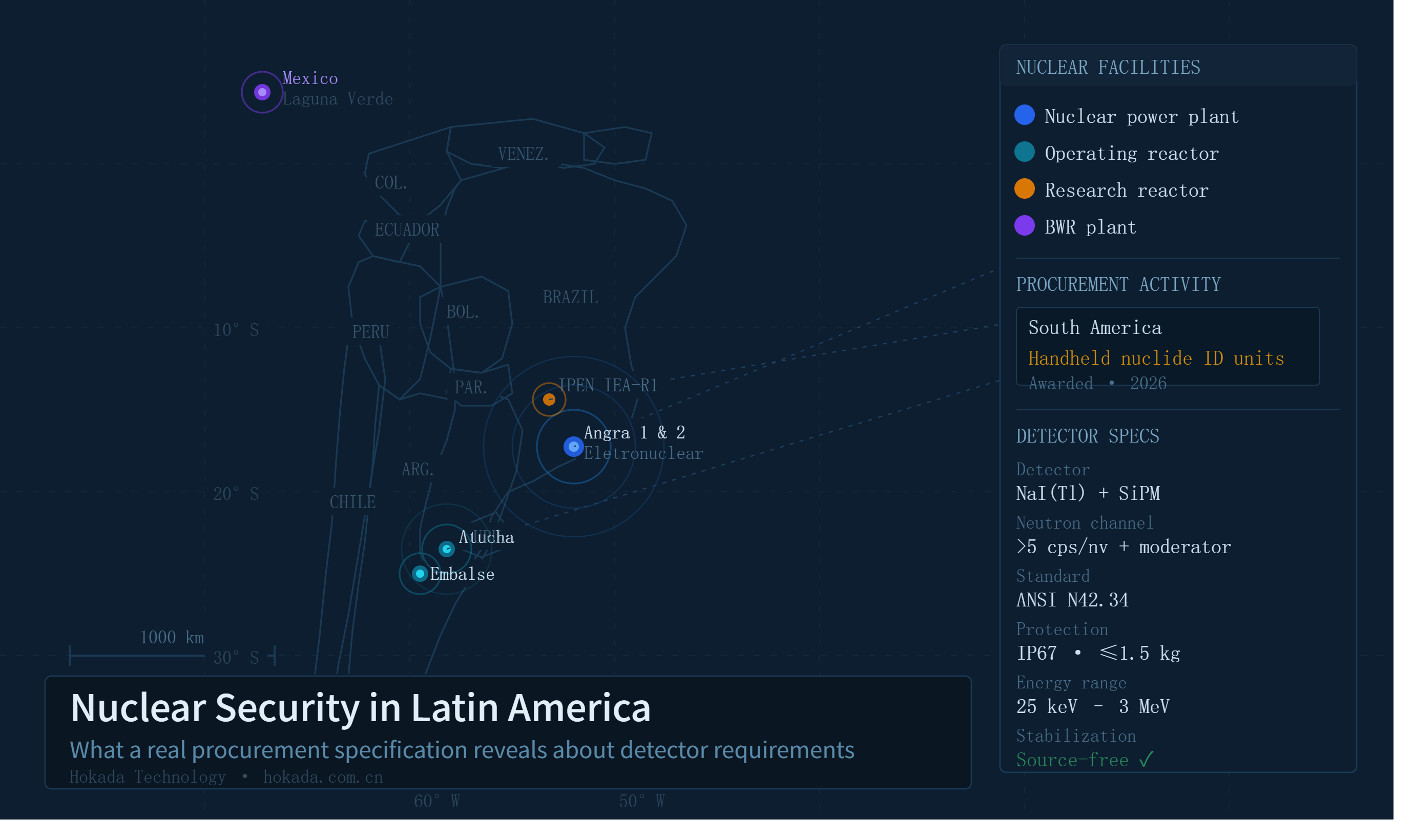
Brazil operates two pressurized water reactor units at the Angra Nuclear Power Plant—Angra 1 (640 MWe, approved for life extension until 2044 in 2024) and Angra 2 (1275 MWe)—with Angra 3 still under construction. The government has outlined plans to build approximately 10 GW of nuclear power capacity by 2050. In March 2025, the Brazilian National Nuclear Energy Commission (CNEN) launched a three-year project to develop 3 to 5 MW containerized micro-reactors. Argentina operates CANDU-type Embalse and Atucha reactors, while the CAREM-25 small modular reactor is under development. Mexico operates two boiling water reactor units at Laguna Verde.
Beyond power generation, the regulatory infrastructure in the region is also maturing. CNEN was established in Brazil in 1956, with its Radiation Protection and Safety Bureau (DRS) responsible for national radiation protection and nuclear safety regulation, while an independent National Nuclear Safety Agency (ANSN) is being established. The evolution of the regulatory system directly drives the procurement cycle for detection and monitoring equipment.
The global nuclear radiation detection market is projected to reach approximately $2.4 billion in 2024, with a compound annual growth rate of 6.7%. Latin America is an emerging segment of this market, characterized by a shift from heavy reliance on Western suppliers to more diversified procurement—partly due to budget constraints and partly due to the desire to obtain equivalent technical specifications at more competitive prices.
In this context, a recent procurement of portable radioactive nuclide identification detectors initiated by a government agency in South America provides a window into the real demand of the market.
Analyzing a Real Procurement Specification
The following analysis is based on the real procurement specifications from a government agency in South America (the agency's information has been anonymized at the request of the procurer). Technical requirements are quoted verbatim—these requirements themselves reveal the demand logic of a mature procurer in this market.
Detector Configuration: Why NaI(Tl)+SiPM?
The specification requires a cubic sodium iodide (NaI(Tl)) scintillation crystal paired with a silicon photomultiplier (SiPM), with a crystal volume of no less than 40 cubic millimeters equivalent. The choice of this combination warrants explanation.
Sodium iodide (NaI(Tl)) is the primary detector for γ energy spectrum measurements—widely deployed, well-researched in performance characteristics, and cost-effective. Under typical conditions, its energy resolution at 662 keV is about 6% to 8% FWHM, which is sufficient for the main applications of field nuclide identification. This specification reflects a deliberate trade-off: while meeting the minimum performance requirements for the application scenario, a reasonable detector solution is chosen to procure more units within budget.
SiPM replaces traditional photomultiplier tubes (PMT) for practical reasons: SiPMs are more compact, operate at lower voltages (typically 20 to 30 V, while PMTs require 700 to 1200 V), are not affected by magnetic fields, and have significantly higher mechanical reliability—this is particularly important for portable instruments subjected to field operations. The NaI(Tl)+SiPM combination represents the mainstream solution for current portable γ spectrometers, achieving a balance between performance, cost, and reliability.
The specification also requires an energy detection range covering 25 keV to 3 MeV—the lower limit is crucial for detecting low-energy emitters such as Am-241 (59.5 keV) and Pu-239 (via its 51.6 keV characteristic line), which are relevant in nuclear safety and safeguards applications.
Neutron Detection Channel: Dual Threat Scenario Demand
The specification requires a neutron detector equipped with a moderator plate, with a sensitivity greater than 5 counts per second/neutron flux (cps/nv), which is significant. It indicates that the instrument is aimed at nuclear safety applications—specifically, detecting special nuclear materials (SNM) such as highly enriched uranium and plutonium, which emit characteristic neutrons alongside γ rays.
Detection of fast neutrons through moderated detectors (typically He-3 or Li-6 based materials, with a polyethylene moderation layer) allows for a sensitive response to fission neutrons in the MeV energy range, not limited to thermal neutrons. The sensitivity threshold of 5 cps/nv aligns with the need to detect shielded fission materials at practical operational distances.
The requirement for simultaneous γ energy spectrum measurement and neutron detection through a dual-channel approach significantly narrows the range of compliant instruments, which also explains the relatively high cost per instrument in such procurements.
Stability Requirement: No Built-in Radioactive Source Needed
"No built-in radioactive source is required for spectrometer stability" reflects real operational experience. Instruments relying on built-in calibration sources (typically small Am-241 or Cs-137 sources embedded in the detector housing) can lead to a series of logistical and regulatory issues:
- Radioactive material licenses and transport documentation
- Periodic recalibration due to source activity decay
- Disposal of radioactive sources when the instrument is decommissioned
An alternative—using environmental background radiation (typically the characteristic peak of K-40 at 1460 keV) for digital gain stabilization, or employing proprietary algorithms—completely eliminates the above issues. This requirement is increasingly common in government procurements, particularly in countries with strict radioactive material control.
Energy Resolution: Significance of the 8% FWHM Threshold
The specification sets the resolution requirement at FWHM ≤ 8% at 662 keV. This criterion is deliberately set at the practical performance limit of high-quality NaI(Tl) crystals—achievable through high-quality crystals and good signal processing design. The threshold is intended to exclude low-quality or aging instruments while not demanding the premium costs of LaBr3(Ce) (with FWHM as low as 2% to 3%) or CeBr3.
For the identification needs of the target nuclide library—primarily including characteristic nuclides of SNM, medical isotopes, and common natural radioactive nuclides—an 8% resolution is operationally sufficient. Nuclides such as Cs-137, Co-60, I-131, and Am-241 can be clearly and unambiguously identified at this resolution. The challenge lies in nuclides with densely packed energy lines (for example, distinguishing U-235 and Ba-133 in certain energy ranges)—this is an inherent limitation of the NaI(Tl) platform, which the specification accepts.
Physical and Environmental Requirements
Several physical indicators are noteworthy:
The total weight of the instrument must not exceed 1.5 kilograms, which is a quite stringent target for instruments that simultaneously integrate γ energy spectrum measurement (detector components + digital MCA + high-voltage power supply) and neutron detection (moderated detector + electronics). Achieving this weight while meeting detection performance requirements necessitates substantial engineering efforts in mechanical design and component integration.
An IP67 protection rating (submersion in 1 meter of water for 30 minutes) rather than IP65 (water spray protection) indicates that the instrument is expected to be used in environments where the risk of immersion is real—such as flood scenarios, maritime applications, or harsh outdoor conditions.
The operating temperature range of -30°C to +50°C covers the full range of deployment environments in Latin America, from the high-altitude low-temperature conditions of the Andes to tropical coastal operations.
Battery continuous operation time must exceed 11 hours, supporting a full operational day without recharging—this practical requirement necessitates the integration of a large-capacity battery or proactive power management in the electronics design.
ANSI N42.34 Standard Requirements
Compliance with ANSI N42.34—the American National Standard for handheld radionuclide identification devices—is a noteworthy requirement in this South American procurement specification. This standard, developed by IEEE and the American National Standards Institute, specifies performance requirements for radionuclide identification accuracy, radiation source detection sensitivity, and overload response behavior.
Its inclusion in the South American procurement specification reflects the region's historical alignment with North American technical standards (rather than European IEC standards, which dominate procurement specifications in other regions). For suppliers, ANSI N42.34 compliance requires formal testing and documentation support—it is not a parameter that can be self-declared.
Data and Connectivity Capabilities
The specification requires WiFi or Bluetooth connectivity, a built-in web interface accessible via USB or WiFi, and at least 25 MB of data storage capacity. These requirements reflect an operational model of networking field instruments—data is uploaded to a central system rather than manually recorded, and instrument configurations can be updated remotely.
The requirement for a built-in web interface is particularly noteworthy: it means that the instrument's configuration parameters, energy spectrum data, and radionuclide identification results can be accessed through standard web browsers without the need for dedicated proprietary software. In environments with strict software control policies, this significantly simplifies IT integration.
What This Specification Tells Us
Several conclusions can be drawn from this procurement specification:
Budget-performance optimization is the dominant procurement logic. The choice of NaI(Tl) over high-resolution alternatives, combined with the 1.5-kilogram weight constraint, reflects a deliberate decision to maximize the number of units procured while meeting the minimum performance threshold for the application scenario within a fixed budget. This is rational procurement, not a lowering of standards.
Nuclear safety applications drive the highest technical requirements. The neutron detection channel, ANSI N42.34 compliance requirements, and IP67 protection rating collectively point to applications in homeland security and border control, rather than industrial radiation safety. This aligns with a larger trend: capacity-building projects conducted by the International Atomic Energy Agency (IAEA) through the Nuclear Safety Fund in Latin American member states are directly translating into equipment procurement needs.
Regulatory maturity is accelerating procurement cycles. The life extension of Angra 1 until 2044, the construction of Angra 3, and the establishment of the new independent regulatory agency ANSN all indicate a long-term commitment to the nuclear energy sector. The procurement cycles for equipment in this environment are expanding—and increasingly looking beyond traditional North American and European suppliers.
Connectivity and data integration are now baseline expectations, not premium features. The web interface and wireless connectivity requirements, which would have been considered advanced features five years ago, have now become the minimum requirements for mature government procurement. Suppliers lacking these capabilities are effectively excluded from this market segment.
Implications for Suppliers
For instrument suppliers considering entering the Latin American market, this specification clearly outlines the key parameters that determine competitiveness:
Technically compliant instruments must simultaneously meet the NaI(Tl)+SiPM detector configuration, neutron sensitivity thresholds, and ANSI N42.34 compliance—these are the technical entry barriers. Beyond compliance, differentiated competition occurs in weight, battery life, data integration capabilities, and total cost of ownership over the full lifecycle (including calibration and maintenance).
A competitive price, dual-channel detection capability, passive stability, and integrated connectivity—all accompanied by verifiable ANSI N42.34 testing documentation—define the competitive boundaries of this market. As Latin America's nuclear infrastructure continues to expand, suppliers that can meet all four of these conditions will be well-positioned in the region's growing nuclear safety procurement budgets.