
This article is written from the perspective of overseas buyers and procurement decision-makers—not to defend Chinese suppliers, but to attempt to provide a rare straightforward analysis in this field.
In procurement offices around the world, in the corridors of industry conferences, and in laboratory procurement committees, a conversation is taking place—usually privately and rarely put into writing. The gist is as follows:
"This Chinese instrument meets the technical specifications perfectly. The price is significantly more competitive. The delivery time is shorter. But if something goes wrong, I can't explain this choice."
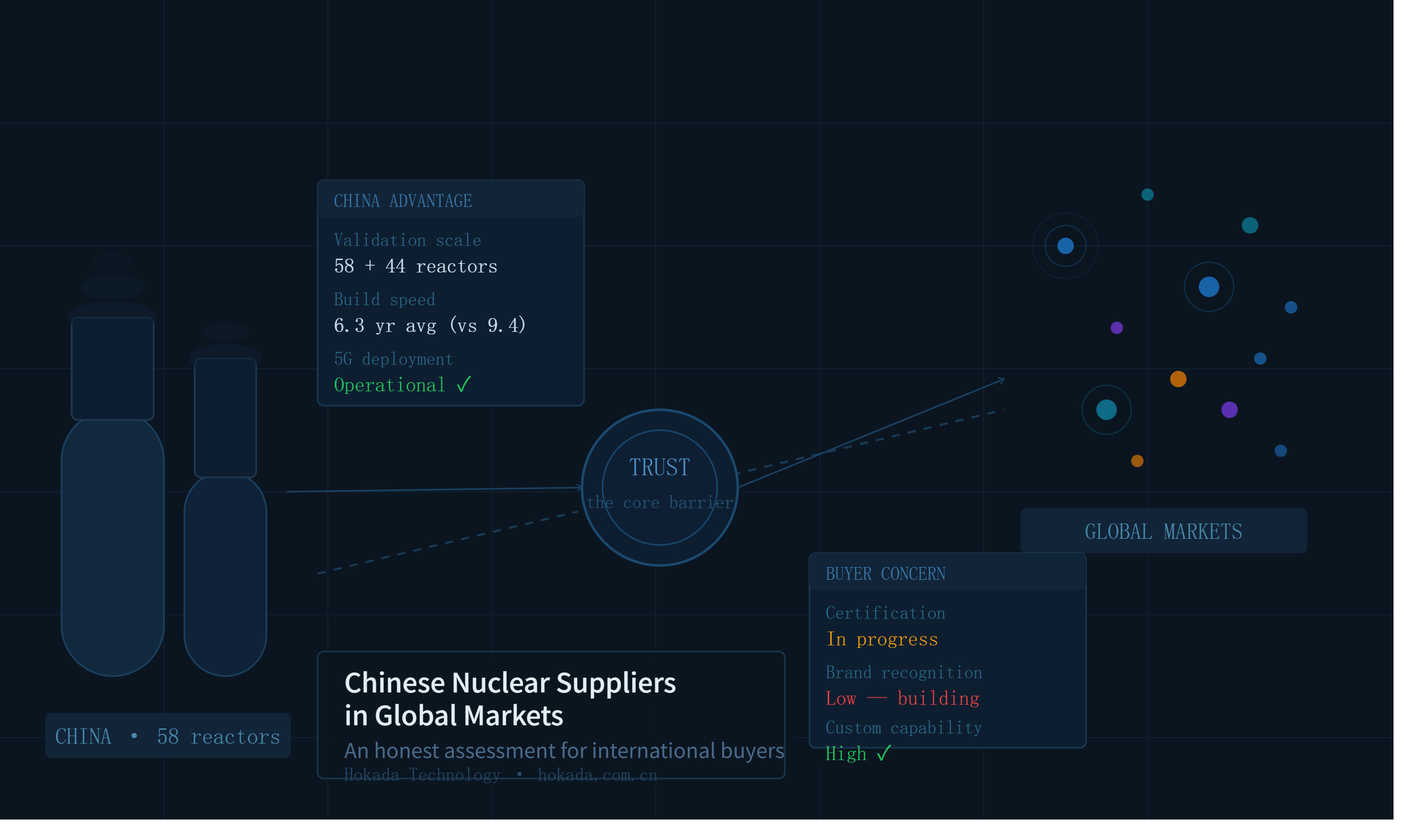
That last sentence is the real issue. It’s not about technology, not about price, and not even about geopolitics. The core challenge faced by Chinese nuclear instrument suppliers in the international market can be summed up in one word: trust—more specifically, the organizational and professional risk that procurement decision-makers bear when choosing non-traditional suppliers in safety-critical industries.
All other issues—certification gaps, brand recognition, after-sales concerns, geopolitical considerations—are manifestations of this core problem.
Why Trust is Harder to Establish in the Nuclear Industry
Nuclear safety culture is inherently conservative. The principle of "proven and certified" exists for good reason: the consequences of instrument failure in radiation monitoring or nuclear safety applications are asymmetrical. A false sense of security is more dangerous than no monitoring at all.
This conservatism structurally favors established suppliers—not because traditional suppliers are necessarily better, but because their track records can be verified within important professional networks. When procurement officials from European nuclear companies or Southeast Asian regulatory agencies choose Mirion, Thermo Fisher, or Bertin, they are not just buying an instrument; they are making a defensible decision. Their technical committees recognize these brands, their auditors accept these certifications, and their peers have used this equipment.
Choosing an unfamiliar supplier—no matter how obvious the technical advantages—completely changes this equation. Procurement officials now bear personal professional risk. If the instrument underperforms, the question will not be "Did it meet specifications?" but rather "Why did you buy from a company no one has heard of?"
This is not irrational. It is a rational risk aversion in an organizational context. Understanding this is the starting point for any objective assessment of the current situation for Chinese suppliers.
Concrete Manifestations of the Trust Gap
The trust deficit has four specific manifestations:
Certification Gaps. Compliance with internationally recognized standards—ANSI N42.34, IEC 62401, CE certification for the European market—requires formal third-party testing and documentation support. Many Chinese nuclear instrument manufacturers, including genuinely capable companies, prioritize deepening their domestic market (which adheres to the GB/T series of national standards). The result is that international buyers cannot verify product performance based on frameworks recognized by their own regulatory agencies. This is not a technical issue but a documentation and qualification certification issue—yet it has substantial implications for procurement decisions.
Brand Invisibility. In the professional networks where nuclear procurement decisions are formed—IAEA technical meetings, nuclear safety summit working groups, industry exhibitions—Chinese instrument suppliers are largely absent. Their names do not appear in the references of peer-reviewed studies, and their application engineers do not speak at seminars. The result is that "I've never heard of this company" becomes the default response, and in the nuclear procurement field, "unknown" often equates to "unqualified."
After-Sales Uncertainty. Radiation monitoring instruments purchased today need support, calibration, and maintenance for the next ten to fifteen years. International buyers reasonably ask: Will this supplier still be around? Will spare parts still be available? Will software updates continue? Can technical experts be contacted when needed? These are not hypothetical concerns—they reflect real situations that have occurred: some suppliers have exited the market or reduced international support after completing initial sales.
Geopolitical Exposure. For applications involving homeland security, border control, or defense—which are significant components of the nuclear detection market—procurement decisions involving Chinese suppliers face additional scrutiny. Whether this scrutiny has technical justification in specific cases is another matter, but it is a real factor that adds organizational costs to decision-making, regardless of instrument performance.
Reasons Worth Serious Consideration
After honestly stating the above challenges, the reasons for reconsidering capable Chinese suppliers are also real—and more persuasive than price.
China is the largest and most active nuclear market globally, with significant advantages.
As of mid-2025, China has 58 commercial nuclear power units in operation with a capacity exceeding 60.7 GW, and another 44 units under construction with a capacity of 52.4 GW. The scale of China's under-construction units exceeds the total of all other countries combined. The goal of the 15th Five-Year Plan is to achieve an operational nuclear power capacity of 110 GWe by 2030.
This is not background information; it is the foundation of the core argument.
When a supplier's instruments are deployed in dozens of operational units, in environmental monitoring networks covering coastal and inland sites, and in emergency response systems for real nuclear facility perimeter testing—this supplier has a validation environment that no laboratory testing protocol can replicate. Between 2015 and 2024, China built 37 reactors, with an average time from the first concrete pour to grid connection of 6.3 years, better than the global average of 9.4 years. Each project requires instrument procurement, installation, commissioning, and operational validation.
The practical consequence is that leading Chinese nuclear instrument suppliers have accumulated real-world operational data at a scale and speed that suppliers serving smaller, slower markets cannot match.
New technologies are being validated at an industrial scale in China.
Technologies that are still in pilot or demonstration phases in Western nuclear markets have achieved full operational deployment in China. A 5G private network covering the entire nuclear power plant site—combined with high-precision positioning tracking for real-time personal dose monitoring—has been deployed in units like the Yangjiang Nuclear Power Plant, covering over 10,000 personnel. Drone radiation survey systems, quadruped robotic platforms for contamination area NBC reconnaissance, and AI-assisted nuclide identification algorithms: these are not research projects in China but deployed systems with operational data.
The depth of the supply chain supporting this scale of nuclear reactor construction also supports instrument R&D: availability of components, rapid prototyping, production flexibility, and a cost structure that Western suppliers cannot match without fundamentally changing their business models.
The result is a truly difficult-to-replicate combination of capabilities: capable Chinese nuclear instrument suppliers operate in the world's largest validation environment, have a complete local supply chain, and their engineering teams rapidly iterate due to domestic customer demands, making small-batch custom development economically viable—something Western suppliers would refuse. This is not a price argument but a structural capability argument.
The Most Persuasive Scenario: When Standard Products Do Not Exist
The most persuasive scenario for collaborating with capable Chinese suppliers is not in standard products with mature Western alternatives and high switching costs, but in a specific, underserved scenario: when what the buyer needs does not exist in the standard product catalog of traditional suppliers.
Research institutions, national laboratories, and specialized government agencies often encounter this situation. The demand may be for a portable spectrometer with a specific detector configuration, a custom solution integrating γ and neutron detection on a weight-constrained platform, or a dose monitoring system designed around communication infrastructure that Western suppliers have never dealt with.
In this case, the relevant comparison is not "Chinese supplier vs. Mirion," but rather "Chinese supplier vs. waiting eighteen months for a Western supplier to assess feasibility and then signing a multi-year development contract that exceeds the agency's capital budget."
For this specific scenario, capable Chinese suppliers offer: engineering response speed, supply chain flexibility, technical depth, and a cost structure that makes small-batch custom development economically viable. This is also the scenario where the trust gap is easiest to manage—because research institutions typically have stronger technical capabilities to independently assess suppliers, and the procurement framework allows trust to be built incrementally.
Evaluation Framework for Buyers
For buyers genuinely considering Chinese nuclear instrument suppliers, the following criteria can distinguish capable suppliers from others:
Verifiable Technical Background. Does the founding or technical team have a traceable academic and engineering background? Are their algorithms and methods documented to allow independent engineers to evaluate them?
Domestic Deployment Record. Has the supplier's equipment been deployed in Chinese nuclear power plants, research reactors, or government projects? This can be verified through technical publications, facility references, and participation in the formulation of Chinese national standards.
Engagement with International Standards. Even if complete certification is not yet in place, is the supplier aware of and striving to achieve ANSI N42.34, IEC standards, or CE compliance? The trajectory of development is as important as the current status.
Custom Development Record. Has the supplier successfully completed custom development projects with international clients? Appropriate due diligence can verify previous collaboration references.
Support Commitment. Are there clear terms for technical support, calibration services, and spare parts supply for international clients?
Direct Conclusion
The trust gap is real. The organizational risks that procurement decision-makers bear when choosing non-traditional suppliers in safety-critical industries are real. These are barriers that cannot be dismissed with technical specifications.
But the competitiveness of capable Chinese nuclear instrument suppliers is also real—and it is most persuasive precisely in the scenarios where traditional suppliers are least adept: custom needs, small batches, urgent timelines, limited budgets, and cutting-edge applications that existing standard products cannot meet.
Trust is not given; it is built gradually through successful deliveries, technical publications, and honest acknowledgment of one’s limitations. Some Chinese nuclear instrument suppliers are doing this work. For buyers, the question is whether they are willing to examine closely enough to identify those who are truly capable.
Hokada Technology is a manufacturer of nuclear electronics, radiation detection instruments, and CBRN detection systems based in Shenzhen, founded by PhD graduates from Tsinghua University's Department of Engineering Physics. For technical inquiries, please contact [email protected].