
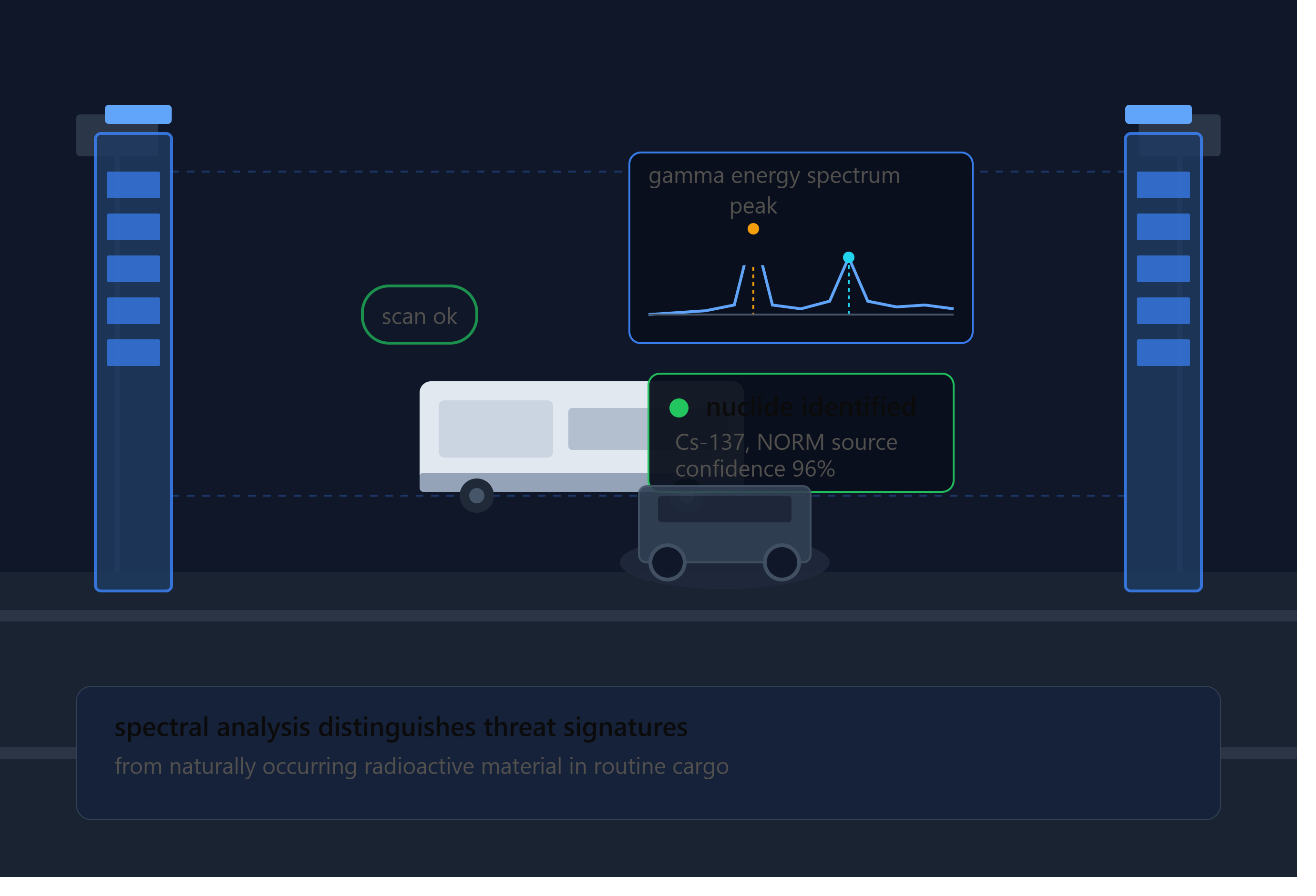
There is a long-standing yet rarely discussed issue in the field of radiation detection: most alarms are false.
Radiation Portal Monitors (RPMs) deployed at ports, airports, and border crossings trigger alarms daily, the vast majority of which do not represent actual nuclear material threats but rather "interference alarms"—caused by naturally occurring radioactive materials (NORM) such as tiles, fertilizers, cat litter, and even travelers who have just undergone nuclear medicine examinations. Each alarm means a time-consuming secondary inspection, and when interference alarms account for the majority of total alarms, the overall usability of the monitoring system is severely compromised.
This is precisely the core driving force behind the significant introduction of artificial intelligence technology in the fields of gamma spectroscopy and radionuclide identification in recent years—not to replace detector hardware, but to enable existing hardware to provide more accurate judgments.
Historical Lessons from the ASP Project's Failure
Before discussing what AI can do, it is essential to understand a cautionary historical example. The United States once promoted the Advanced Spectroscopic Portal (ASP) project, aimed at replacing traditional plastic scintillators with NaI(Tl) scintillators to reduce interference alarm rates through better energy resolution. This project was ultimately canceled in 2011—not due to a wrong technical direction, but because of persistent high false positive rates and system stability issues during actual deployment, and its performance did not significantly surpass that of traditional systems with lower costs.
This history provides an important reference: merely relying on better hardware does not automatically solve the false alarm problem. The real bottleneck often lies in the capabilities of signal processing and discrimination algorithms, which is precisely the area where artificial intelligence technology has made substantial progress in recent years.
Practical Advances of AI in Radionuclide Identification
Research in academia over the past five years has been quite dense in this direction. Convolutional Neural Networks (CNNs) are currently the mainstream method used to directly identify radionuclide types from gamma spectra—studies have shown that these networks can learn the photopeak and Compton edge features of energy spectra and still provide reliable judgments under low count and low signal-to-noise ratio conditions, which are the most common challenging scenarios encountered in field detection (as opposed to laboratory conditions).
More practically valuable is a research direction known as "explainable AI." Early deep learning radionuclide identification models had a practical issue: the models provided judgments but could not explain the basis for those judgments, which is unacceptable for security personnel who need to take responsibility. Research in 2025 proposed a method based on Class Activation Mapping, which can visualize the specific areas of the energy spectrum that the neural network "focuses" on, demonstrating that the network's judgment logic is indeed based on physical features like photopeaks rather than coincidental patterns in statistical noise—this work is gradually transforming AI radionuclide identification from a "black box" into a tool that can be trusted by professionals.
Another practical application case comes from the ERNIE system (Enhanced Radiological Nuclear Inspection and Evaluation) deployed by the Pacific Northwest National Laboratory in the United States. This is a machine learning-based alarm analysis system that has been implemented in the U.S. and several international locations. Public data shows that this system has reduced the rate of interference alarms by an order of magnitude while maintaining or even enhancing the detection sensitivity to real threats. This is one of the most concrete pieces of evidence regarding the substantial benefits of AI in radiation security scenarios available in public records.
Real-World Limitations: Shielding Scenarios Remain a Challenge
To be honest, AI radionuclide identification has not yet reached the level of "solving the problem." Multiple studies have repeatedly pointed out the same limitation: when the shielding material and internal configuration of the sample to be tested are unknown—this is precisely the most common and dangerous situation in nuclear security scenarios—the model's identification accuracy significantly decreases. Most publicly available research uses training datasets that either have a limited variety of radionuclides or have significant gaps between major energy peaks, making them easy to distinguish. However, the composite signals of mixed radionuclides accompanied by unknown shielding in real scenarios remain a weak point for current algorithms.
Additionally, the "sim-to-real" domain adaptation problem is also a persistent engineering challenge: models that perform well on simulated data often experience performance degradation when transferred to data collected by real detectors due to differences in detector response characteristics and environmental backgrounds, requiring specialized domain adaptation techniques to bridge this gap.
What This Means for Practical Deployment
For organizations procuring and deploying radionuclide identification devices, this means that evaluating AI capabilities requires asking several specific questions rather than being swayed by buzzwords like "AI-enabled":
Does the training data cover the shielding conditions and radionuclide combinations that may be encountered in actual deployment scenarios? Is the model's judgment logic verifiable and explainable, rather than purely a black box output? Has the system's real-world performance under low signal-to-noise conditions been independently validated, rather than just tested under ideal laboratory conditions?
The answers to these questions determine whether the AI radionuclide identification capability genuinely enhances detection ability or merely adds a layer of opacity that is difficult to verify.
Conclusion
Artificial intelligence is genuinely improving the ability of radiation detection systems to distinguish between real threats and harmless radioactive backgrounds. The deployment data from the ERNIE system and the growing body of explainable AI research are real signals of progress. However, the historical lessons from the ASP project remind us that any single-dimensional improvement at the hardware or algorithm level cannot simply equate to an enhancement in overall system reliability. Meaningful progress comes from continuous validation of training data coverage, model explainability, and real-world performance—these should be the standards adhered to when evaluating any radionuclide identification device that claims to be "AI-enabled."